
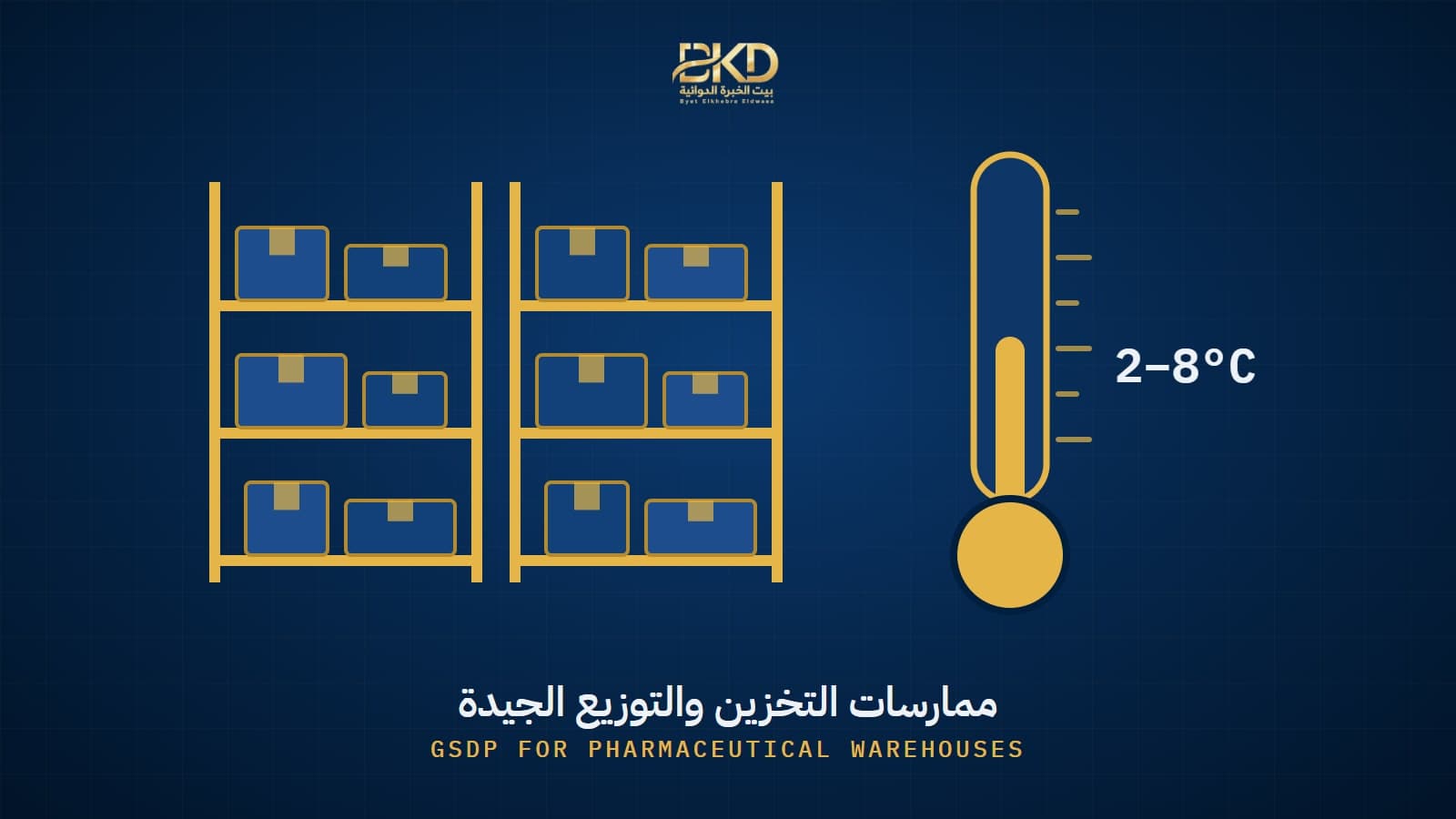
GSDP, or Good Storage and Distribution Practice, is the set of quality expectations that keep medicines authentic, intact and effective while they are stored and moved between companies. This guide explains who needs GSDP, what it covers in a pharmaceutical warehouse, the findings inspectors commonly raise and how to prepare. It is written for warehouse managers, quality staff, importers and distributors.
What does GSDP mean, and who needs it?
GSDP joins two ideas: good storage practice (GSP) and good distribution practice (GDP). Authorities and documents use different labels, but the aim is the same. A medicine leaves the manufacturer with a defined quality and must reach the next party with that quality unchanged, backed by records that show what happened on the way. WHO and EU guidance on good distribution practice are widely used as general references, and many national rules draw on them. The principles apply to small warehouses as well as large ones, scaled to the activity and the risk.
GSDP applies to any business that holds or moves medicines, including:
- Warehouses and depots that store medicines for themselves or for others
- Wholesalers and distributors supplying pharmacies, hospitals and other customers
- Third-party logistics providers and contract warehouses
- Importers, including the store where imported goods wait before release
- Transport companies and couriers that carry medicines
- Manufacturers' own distribution centres
Which of these businesses need a licence or certificate, and which standard is applied to them, is decided by the competent authority and depends on the activity and the product category.
Quality system, premises, cleaning and pest control
Quality system and responsible person
A GSDP warehouse works under a documented quality system: a quality policy, controlled procedures, job descriptions, change control, risk-based decisions and regular management review. ISO 9001 can supply a general framework, and ICH Q9 a sound way to record risk assessments, although neither replaces the distribution requirements themselves. A named responsible person with real authority over quality decisions normally oversees the system, and the applicable requirements set that person's qualifications and duties.
Premises, layout and security
Premises should be clean, dry, in good repair and large enough for orderly work. A typical layout separates goods receipt, approved stock, quarantine, returns, rejected and recalled goods, and dispatch, with clear markings and controlled access. Security measures should prevent unauthorised entry and theft. Where an electronic status system replaces separate physical areas, it normally has to be validated and give equivalent control.
Cleaning and pest control
Cleaning follows a written schedule with records, and products are never stored near waste or cleaning materials. Pest control is usually carried out by a competent contractor under a documented programme, with a map of control points, regular inspections and trend review. Missing records are a frequent finding even when the premises look clean.
Temperature and humidity control, mapping and the cold chain
Every medicine must be kept under the storage conditions stated on its label, and temperature mapping shows whether a storage area can actually deliver them. Calibrated sensors are placed throughout the space, high and low and near doors, windows and cooling units, and readings are taken under representative conditions that include seasonal extremes. The result reveals hot and cold spots, where products with narrow limits should and should not be placed, and where permanent monitoring probes belong. Mapping is generally repeated after significant changes to layout, cooling equipment or use of the area.
Routine control then follows: calibrated monitoring devices, alarm limits, someone who is alerted out of working hours, backup power or a documented plan for outages, and regular review of the data. Equipment such as cold rooms and refrigerators is normally qualified before use. The same logic applies to humidity where the label sets limits.
Cold chain
Refrigerated products, commonly labelled for storage between 2 and 8 °C, and frozen products need controlled handling from the moment a delivery arrives. At receipt, review the data logger or indicator, check the packaging and record the time. Move the goods promptly into qualified storage. For dispatch, use packaging and vehicles tested against the temperatures they will meet in summer and winter, and put a logger in the shipment. Decide in advance what happens if a vehicle is delayed or a refrigerator fails.
When a temperature excursion happens
Isolate the affected stock, record the readings and duration, and refer the decision to the responsible person. Release, rejection or return should rest on documented evidence, often including stability information from the manufacturer, never on a judgement that the product looks fine. Log the event as a deviation, find the root cause and close it with a corrective and preventive action (CAPA).
Receiving, storage, stock control and dispatch
Good practice is easiest to see in the flow of goods:
- Receiving. Check each delivery against the order and delivery note, inspect packaging and seals, confirm product, batch, expiry and quantity, verify that the supplier is an authorised source, and hold the goods apart until they are checked and released.
- Storage. Keep products off the floor and away from walls, in the area that matches their storage conditions, with every location recorded. Apply FEFO (first expired, first out) so that stock closest to expiry leaves first, and count stock regularly against the system records.
- Picking and packing. Pick by batch and expiry as well as by product, check each order before it leaves the picking area, and pack to protect against heat, moisture, light and damage.
- Dispatch. Supply only customers entitled to receive medicines, issue documents that identify product, batch, quantity, sender and recipient, and keep records that let you trace every batch to its customers if a recall is needed.
Segregating quarantined, rejected, returned and recalled stock
Stock that is not cleared for sale should be physically and visibly separate, or controlled by a validated electronic status with equal security. Quarantine holds goods awaiting a decision. Rejected and recalled stock waits in a secure area for return or destruction under documented control. Returned goods go back into saleable stock only after an authorised person has reviewed evidence that they are intact and were stored and transported correctly, and temperature-sensitive returns often cannot be accepted back.
Transport and packaging
Carriers should be assessed and bound by written agreements. Vehicles should be clean, suitable and, where needed, temperature controlled; loads should be secured; and drivers should know what to do during delays. Goods should never be left unattended in the sun or in unsuitable conditions, and every handover should leave a signed record.
Documentation, deviations and CAPA
Inspectors often read the records before they walk the shelves. Procedures, receiving and dispatch records, temperature data, calibration records, cleaning and pest control logs, training files, complaint and return records and audit reports should be complete, legible and current. Entries are made at the time of the activity, never backdated, and corrected so that the original stays visible. Electronic data need access control, audit trails and backup, and the competent authority sets retention periods.
A deviation is any departure from procedure or from the required conditions, such as a missed temperature check, a damaged carton, a wrong pick or a missing document. Record it, protect the product, assess the impact, investigate the root cause and agree a CAPA whose effectiveness you check later. Retraining alone rarely removes the cause, so look at procedures, equipment and workload first, and review deviations together to spot repeating patterns.
Returns, complaints, recalls and falsified medicines
Procedures should explain how complaints are recorded and investigated, how returns are assessed and how a recall is run, including who decides, who is contacted and how stock is retrieved and reconciled. A mock recall tests traceability: choose a batch and see whether you can show every customer who received it.
Falsified medicines enter the legal supply chain through unqualified suppliers and unusual offers. Qualify suppliers and customers, verify their authorisations, and train staff to notice warning signs such as altered packaging, inconsistent batch or expiry details, unusually low prices, documents that do not match the goods and sellers who cannot be verified. A suspect product is quarantined, the responsible person is informed, and the authority and the marketing authorisation holder are notified as required.
Outsourcing, quality agreements and self-inspection
Storage, transport, calibration, cleaning and pest control are often outsourced. Responsibility for product quality stays with the licence holder or product owner, so each contractor needs assessment before use, periodic review and a written quality agreement covering duties, temperature responsibilities, change notification, deviation reporting, recall support, subcontracting and audit rights.
Self-inspection, backed by an independent audit or mock inspection, is how you find your own problems first. Plan a programme that covers every area over time, give more attention to higher-risk activities such as the cold chain, use trained staff who do not audit their own work, report to management and track every finding to a closed CAPA.
What do inspectors typically find, and how do you prepare?
Inspection reports on storage and distribution sites tend to repeat the same themes:
- Temperature mapping that is missing, outdated or ignores seasonal extremes, and sensors placed without a rationale
- Uncalibrated monitoring equipment, and alarms with no evidence of a response
- Temperature excursions that were not investigated, or stock released without documented justification
- Quarantined, rejected or returned stock that is not clearly separated
- FEFO not applied, expired goods in saleable locations, and stock counts that do not match records
- Incomplete, backdated or unsigned records, including cleaning and pest control logs
- Deviations closed without root cause, with retraining as the only CAPA
- No quality agreements with, or oversight of, transporters and contract partners, and no mock recall
Preparation is a sequence rather than a last-minute clean-up:
- Confirm which licence route and standard apply to your activities and product categories.
- Run a gap assessment of premises, equipment, systems, documents and people against that standard.
- Close the critical gaps first: temperature control and mapping, segregation, records and the responsible person's role.
- Write or revise procedures to match what staff actually do, and train everyone on them.
- Run a self-inspection or mock inspection and fix every finding through CAPA.
- Prepare the inspection day: name who accompanies the inspector, keep records retrievable and brief staff to answer honestly and refer questions they cannot answer.
- After the visit, answer each observation with evidence and a corrective plan.
Licensing and inspection requirements for storage and distribution are set by the competent authority, which in Egypt is generally the Egyptian Drug Authority (EDA). They can differ by activity, product category and over time, so confirm the current standard and licence route with the authority or a regulatory consultant before you invest in premises or equipment.
Next step: get your warehouse ready for inspection
GSDP is a working system of premises, equipment, procedures and people, not a document set prepared for the inspector. A gap assessment against the current requirements, followed by a mock inspection, shows where your warehouse really stands.
Our GSDP certification preparation for warehouses covers premises, temperature control, procedures and records and includes a mock inspection, and our GSDP and quality systems training helps your teams apply the practice every day. We prepare you for the assessment; the certificate itself is issued by the competent authority. If you are importing for the first time, our guide on how to register a product in Egypt covers launch planning.